Chinatown Kuala Lumpur: What to Do, Eat, and See in Petaling Street

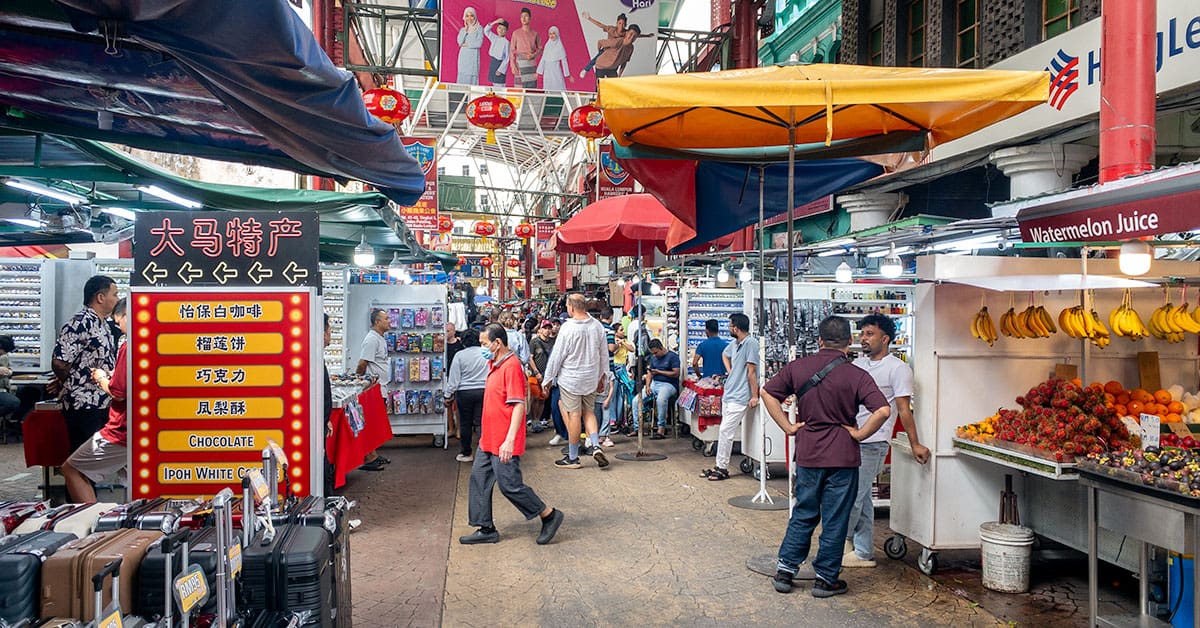
Chinatown Kuala Lumpur is worth half a day for the food and temples. The market on Petaling Street runs mostly on replica goods — come for the kopitiam breakfast, the temple circuit through Sin Sze Si Ya and Guan Di, and Kwai Chai Hong, the mural alley most tourists walk straight past. Best visited between 8am and 11am, or from 5pm onwards when the night market fires up.
Centred on Jalan Petaling and the surrounding streets of the old city, Chinatown is one of the most layered neighbourhoods in Kuala Lumpur — Chinese shophouses from the 1920s sitting next to a Hindu temple, Malay food stalls tucked between Taoist shrines, and a heritage cinema turned creative space a five-minute walk from a night market that runs until late. For a full picture of what to see and plan across the city, start with our Kuala Lumpur travel guide.
What Is Chinatown Kuala Lumpur?
Chinatown Kuala Lumpur — also called Petaling Street or Jalan Petaling — is the original commercial heart of old Kuala Lumpur. The story starts with Yap Ah Loy, the Chinese kapitan who kept the city alive after the Selangor Civil War in the 1870s. He persuaded miners to stay, set up a tapioca mill on what is now Petaling Street, and turned a flood-prone riverside settlement into the foundation of what KL became.
The Cantonese name for Petaling Street is Chee Cheong Kai — Starch Factory Street. That history is still visible in the shophouse architecture lining Jalan Tun H.S. Lee and the streets behind it.
What makes Chinatown different from most city markets is the density of cultures compressed into a few blocks. Chinese Taoist temples, a Tamil Hindu temple, Malay hawker stalls, and Indian textile shops all share the same streets. It’s not a theme park version of multiculturalism — it’s just how the neighbourhood developed over 150 years.
Things to Do in Chinatown Kuala Lumpur
Top things to do in Chinatown Kuala Lumpur:
- Temple circuit — Sin Sze Si Ya (KL’s oldest Taoist temple, built 1864), Guan Di, Sri Mahamariamman
- Kwai Chai Hong — restored 1960s mural alley off Lorong Panggung
- Madras Lane hawker stalls — best breakfast in the area Petaling Street night market — atmosphere peaks 6pm to 9pm
- Central Market — 5-minute walk, air-conditioned, Malaysian crafts and batik
There are four layers to Chinatown: temples, street food, street art, and the market. The temples and food are genuinely worth your time. The street art alley is a short detour that most tourists miss. The market is worth a walk-through for the atmosphere — just don’t expect to find anything you can’t buy elsewhere. If you’re building a broader KL visit, see the full list of attractions in Kuala Lumpur for what else is worth your time in the city.
Temples Worth Visiting
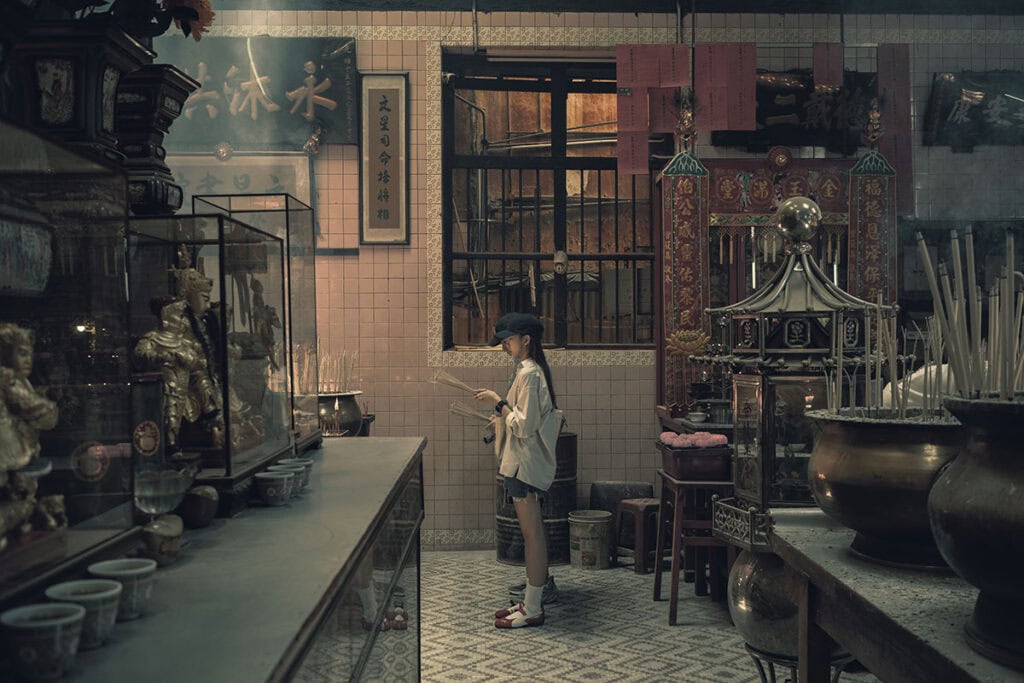
Start with Sin Sze Si Ya Temple on Jalan Tun H.S. Lee. Built in 1864, it’s the oldest Taoist temple in Kuala Lumpur — and also the easiest to miss. The entrance is tucked behind a souvenir stall, so most tourists walk straight past it. Inside, it’s dedicated to Sin Sze Ya and Si Sze Ya, two of Yap Ah Loy’s generals, which ties the temple directly to KL’s founding story. Go in, let your eyes adjust to the incense smoke, and take a few minutes. It’s quiet in a way the street outside isn’t.
A short walk away on the same street is Guan Di Temple, dedicated to the Chinese God of War. This one is easier to find and more widely visited. The interior is gold and red, heavy with incense coils hanging from the ceiling, and locals come here to pray throughout the day. It’s atmospheric and worth ten minutes of your time.
Further along Jalan Tun H.S. Lee sits Sri Mahamariamman Temple — one of KL’s oldest Hindu temples. The carved gopuram tower above the entrance is covered in figurines and visible from the street. This is an active place of worship for the Tamil community, not a tourist attraction, so be respectful.
For something quieter, Chan She Shu Yuen Temple at the southern end of Petaling Street has a courtyard lined with ceramic dragons and sees far fewer visitors than the others. Worth a short stop if you’re walking the full length of Jalan Petaling.
Temple etiquette across all four: remove your shoes before entering, keep shoulders and knees covered, speak quietly, and don’t photograph anyone mid-prayer without asking.
Kwai Chai Hong — The Back Alley Worth Finding
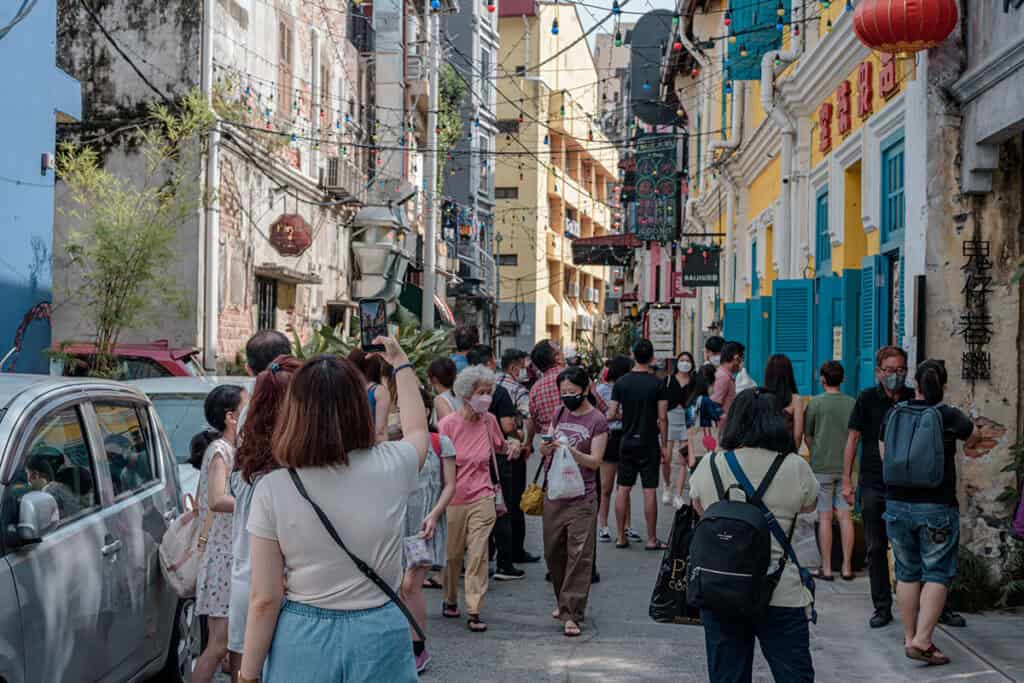
Kwai Chai Hong translates literally as Ghost Lane or Little Demon Alley. It runs along Lorong Panggung, behind the shophouses on Jalan Petaling. The alley was restored and turned into a street art installation depicting daily life in 1960s Chinatown — Chinese settlers going about their routines, old trades, neighbourhood scenes.
The murals are genuinely well done and historically grounded. Each one has a QR code linking to background information about the scene. It’s the kind of detail that makes the visit feel informative rather than just photogenic.
To find it: walk to the southern section of Jalan Petaling and look for Lorong Panggung, or cut through one of the cafés along Jalan Petaling — Da Bao and Bubble Bee Café both have back doors that open into the alley.
Go early morning or late afternoon. Midday the light is harsh for photos and the space gets crowded. First thing in the morning you may have it largely to yourself.
From Kwai Chai Hong, it is a five-minute walk north to REXKL on Jalan Sultan. A 1940s cinema that has been converted into a cultural complex — it now houses BookXcess, one of the more interesting bookstores in KL, spread across the original cinema’s tiered seating and stage. The REXPERIENCE immersive digital show runs inside the main hall if you want something more structured. Even if you just walk through the lobby, it is worth the short detour from the alley.
The Petaling Street Market — What to Expect
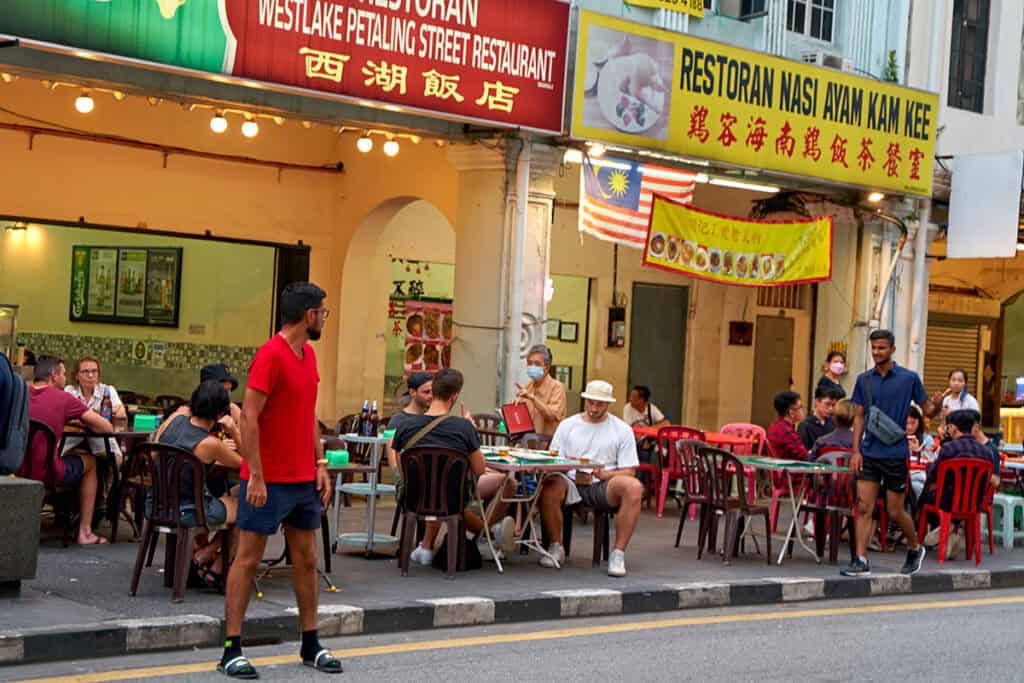
Petaling Street is a pedestrianised, covered market running the length of Jalan Petaling between two large Chinese entrance arches. Stalls line both sides selling clothing, bags, watches, souvenirs, and replica goods.
Here’s the honest version: the shopping is generic. Most stalls sell similar products, and the replica goods are exactly what they look like — imitations. Bargaining is expected and the vendors are experienced at it, so if you engage, treat it as a game rather than a transaction you’ll win.
The market is worth a walk-through for the atmosphere, the red lanterns overhead, and the noise of it. If you’re after genuine local goods, Central Market a five-minute walk away has a better selection of Malaysian crafts and batik.
What to Eat in Chinatown Kuala Lumpur
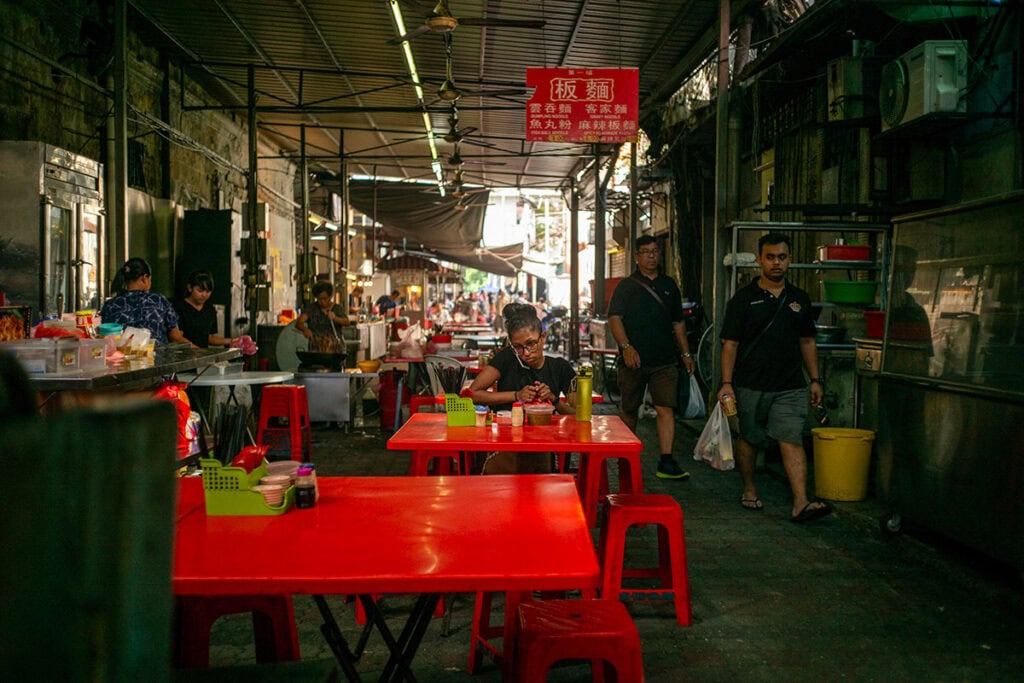
Best food in Chinatown Kuala Lumpur:
- Wantan mee — springy egg noodles with char siu pork, available all day
- Char kway teow — flat rice noodles wok-fried over high flame
- Chee cheong fun — steamed rice rolls from Madras Lane off Jalan Hang Lekir
- Tau fu fa — silky soybean pudding from street carts
- Kopi — traditional coffee brewed through a cloth filter at any kopitiam
- Longan herbal drink — cold, sweet, ideal after walking in the heat
Food is the real reason to come to Chinatown. The distinction between morning and evening matters here because the food is different at each time.
Morning — kopitiam and hawker stalls
The kopitiam culture in Chinatown is worth experiencing on its own. These are old-school Chinese coffee shops that have been serving the same things for decades: kopi (thick, sweet coffee brewed through a cloth filter), soft-boiled eggs with soy sauce, and kaya toast. Pull up a plastic chair, order slowly, and take your time.
For breakfast hawker food, Madras Lane is the place. It’s a narrow lane just off Petaling Street — easy to miss, always worth finding. The stalls here serve chee cheong fun (steamed rice rolls with sweet sauce), laksa, and yong tau foo. Most have been operating for decades. Go before 11am — some stalls sell out and close early.
All-day and evening
Wantan mee — springy egg noodles with char siu pork and wontons in broth — is one of the best things you can eat in Chinatown. Several old-school shops along Jalan Tun H.S. Lee and the surrounding streets have been serving the same recipe for generations.
Char kway teow — flat rice noodles wok-fried with egg, bean sprouts, and cockles — is worth ordering if you see it being cooked fresh in a wok over high flame. The wok hei (breath of the wok) is what makes it.
For something cold: tau fu fa (silky soybean pudding with palm sugar syrup) from a street cart, or a longan herbal drink from one of the drinks stalls near Petaling Street. Both are better than they sound and exactly what you want after walking in the heat.
Evening — bars and speakeasies
For evenings, Chinatown has a well-established bar scene hidden behind unremarkable shophouse fronts. PS150 on Jalan Petaling is the most well-known — a bar built inside a restored pre-war building with a long cocktail list and a crowd that fills up after 9pm. Jann and The Attic Bar are worth knowing about if you plan to stay past that. None of them announce themselves loudly from the street, which is part of the appeal — look for a small sign or a door that seems like it shouldn’t be open.
Best Time to Visit Chinatown Kuala Lumpur
|
Time |
Best for |
Crowd Level |
|---|---|---|
|
8am – 11am |
Kopitiam breakfast, temples, Kwai Chai Hong |
Low |
|
11am – 5pm |
Browse only — avoid midday heat |
Medium–High |
|
5pm – 9pm |
Night market, street food, atmosphere |
High |
|
Weekday |
Any activity |
Lower than weekend |
|
Weekend evening |
Night market peak |
Very high |
There are two windows that work well, and one stretch of the day to avoid.
8am to 11am is the best time for food and temples. The kopitiam stalls are open, Madras Lane is running, the temple courtyards are quiet, and the heat hasn’t built yet. Kwai Chai Hong is uncrowded. The night market stalls along Petaling Street won’t be set up yet, but the permanent shops are open from around 9am.
5pm to 9pm is when the neighbourhood changes character. The night market stalls fill in the middle of Petaling Street, the red lanterns come on as it gets dark, food stalls fire up for the dinner crowd, and the whole place gets busier and louder. If atmosphere is what you’re after, this is the time. For Petaling Street specifically, 6pm to 9pm is the peak.
Avoid 12pm to 3pm. The heat in KL is serious and Petaling Street, for all its covered sections, does not have air-conditioning. If you’re here at midday, duck into Central Market for a break — it’s five minutes away and fully air-conditioned.
Weekdays are noticeably quieter than weekends. If you have flexibility, a Tuesday or Wednesday morning is a different experience from a Saturday evening.
How to Get to Chinatown Kuala Lumpur
The easiest way is by rail. Pasar Seni station is served by two lines — the Kelana Jaya Line (MRT) and the Ampang/Sri Petaling Line (LRT). Both stop here. From the station exit, Petaling Street is under a five-minute walk — follow the crowd or the signage. You can plan your journey using the RapidKL route planner.
If you’re coming from the Masjid Jamek area or the old city centre, it’s an eight-minute walk south along the river. That walk passes the Klang River confluence — the exact spot where Kuala Lumpur was founded — which is worth noting if you’re interested in the history.
E-hailing is a straightforward alternative, particularly if you’re arriving from KLCC or Bukit Bintang. Drop-off is on the streets surrounding Petaling Street — the road itself is pedestrianised.
If you’re planning to combine Chinatown with Batu Caves and the Petronas Twin Towers in a single day, getting between three locations across KL by public transport adds real friction — waiting for trains, figuring out drop-off points, and timing arrivals around crowds. Our Batu Caves and Kuala Lumpur City Tour covers all three stops with private transport included, so the logistics are handled and you move on your schedule, not the rail timetable.
What’s Near Chinatown Kuala Lumpur
Central Market is five minutes on foot from the southern end of Petaling Street. It’s housed in a 1930s Art Deco building and sells Malaysian crafts, batik, silverwork, and regional food products. Air-conditioned, fixed prices, and a good place to spend RM20 to RM30 on something genuinely local. The Kasturi Walk outside runs along the front of the building.
Masjid Jamek is eight minutes north on foot. Built in 1909 at the meeting point of the Klang and Gombak rivers, it sits on the exact site where the early miners and traders who built Kuala Lumpur first settled. The connection back to Yap Ah Loy and Chinatown’s origin story is direct. The mosque is open to non-Muslim visitors outside prayer times — cover up before entering.
Independence Square (Dataran Merdeka) is a ten-minute walk from Chinatown, just past Masjid Jamek. This is where Malaysia declared independence from British rule on 31 August 1957 — the flagpole at the centre of the square is one of the tallest in the world. The square is flanked by the Sultan Abdul Samad Building, a striking Moorish-colonial structure that is one of KL’s most photographed landmarks. It’s open, walkable, and free. Worth fifteen minutes if you’re already in the area.
From Independence Square, Merdeka 118 is visible on the skyline — the world’s second tallest building at 678.9 metres. The observation deck is not yet open to the public, but the Linear Park surrounding the base of the tower is worth a short walk if you want to see the structure up close and get a clear photography angle without the crowds of the city centre.
How to Combine Chinatown with a Full Day in KL
Chinatown works best as one stop in a longer KL day, not a standalone destination. Here’s a sequence that works well without rushing:
Early morning: Batu Caves (7am – 9:30am) Start at Batu Caves before the heat builds and before the crowds peak. The climb is 272 steps. You’ll want an hour to ninety minutes up and back, including time at the top.
Late morning: Chinatown (10am – 1pm) Head into Chinatown for a late breakfast or early lunch. Start with the temple circuit — Sin Sze Si Ya, Guan Di, Sri Mahamariamman — then Kwai Chai Hong, then food. Wantan mee or char kway teow for lunch, followed by tau fu fa from a street cart.
Afternoon break (1pm – 3pm) This is the hottest part of the day. Central Market is the natural stop — air-conditioned, five minutes from Chinatown, and worth an hour for the craft stalls and batik.
Late afternoon to evening: Petronas Twin Towers (4pm onwards) Head to KLCC as the light softens. The Petronas Twin Towers are best seen around sunset when the sky behind them changes colour. The park below the towers is a good place to sit before or after. Book Skybridge tickets in advance — same-day slots go quickly.
Fitting Batu Caves, Chinatown, and the Petronas Towers into one day is achievable but full. The logistics — getting between three separate locations in KL traffic — are where most tourists lose time. A private guided tour handles the routing and transport so you arrive at each place at the right time — our Batu Caves and Kuala Lumpur City Tour covers all three stops with hotel pickup included.
Batu Caves, Chinatown, and the Twin Towers — in one day
A private city tour covers all three stops with transport included — no juggling trains or waiting for e-hailing between locations. Browse all day tours from Kuala Lumpur if you’re planning other destinations.
Practical Tips for Visiting Chinatown Kuala Lumpur
Bring cash. Hawker stalls and kopitiams are almost all cash-only. RM50 in small notes is enough for a full morning of eating and browsing. There are ATMs near Pasar Seni station if you need to top up on arrival.
Keep your bag zipped and front-facing. Petaling Street gets busy, especially in the evening. Pickpocketing is not common but the crowds create opportunity. Keep your phone in a front pocket, not a back one.
Wear comfortable shoes. Petaling Street’s covered section is flat, but the backstreets and Kwai Chai Hong are cobbled and uneven. Sandals work but anything without a decent sole will slow you down.
Dress for temples. Shoulders and knees covered — this applies to all four temples mentioned above. Sin Sze Si Ya and Guan Di are informal enough that a light layer over your shoulders is sufficient. Sri Mahamariamman is stricter — full coverage is expected.
Don’t photograph people at prayer without asking. The temples are active places of worship. Watching is fine. Photography of people mid-ritual is not unless you’ve asked and received a nod.
Don’t ask for prices unless you’re ready to buy. Once you ask a vendor for a price and start negotiating, you’ve entered a social agreement. If the seller meets your offer and you walk away, expect tension. Browse freely, but only open a price conversation when you’ve already decided you want the item.
The heat is real. KL’s midday heat is not the kind you push through cheerfully. If you’re visiting between 12pm and 3pm, plan for a midday break indoors — Central Market, a kopitiam, or one of the cafés along Jalan Petaling. That heat window also tends to roll straight into the city’s typical afternoon storms, so if you’re planning your whole day around it, our best time to visit Kuala Lumpur guide covers the monthly and daily patterns in more depth.