Thaipusam at Batu Caves: Dates, What to Expect, and How to Visit as a Tourist

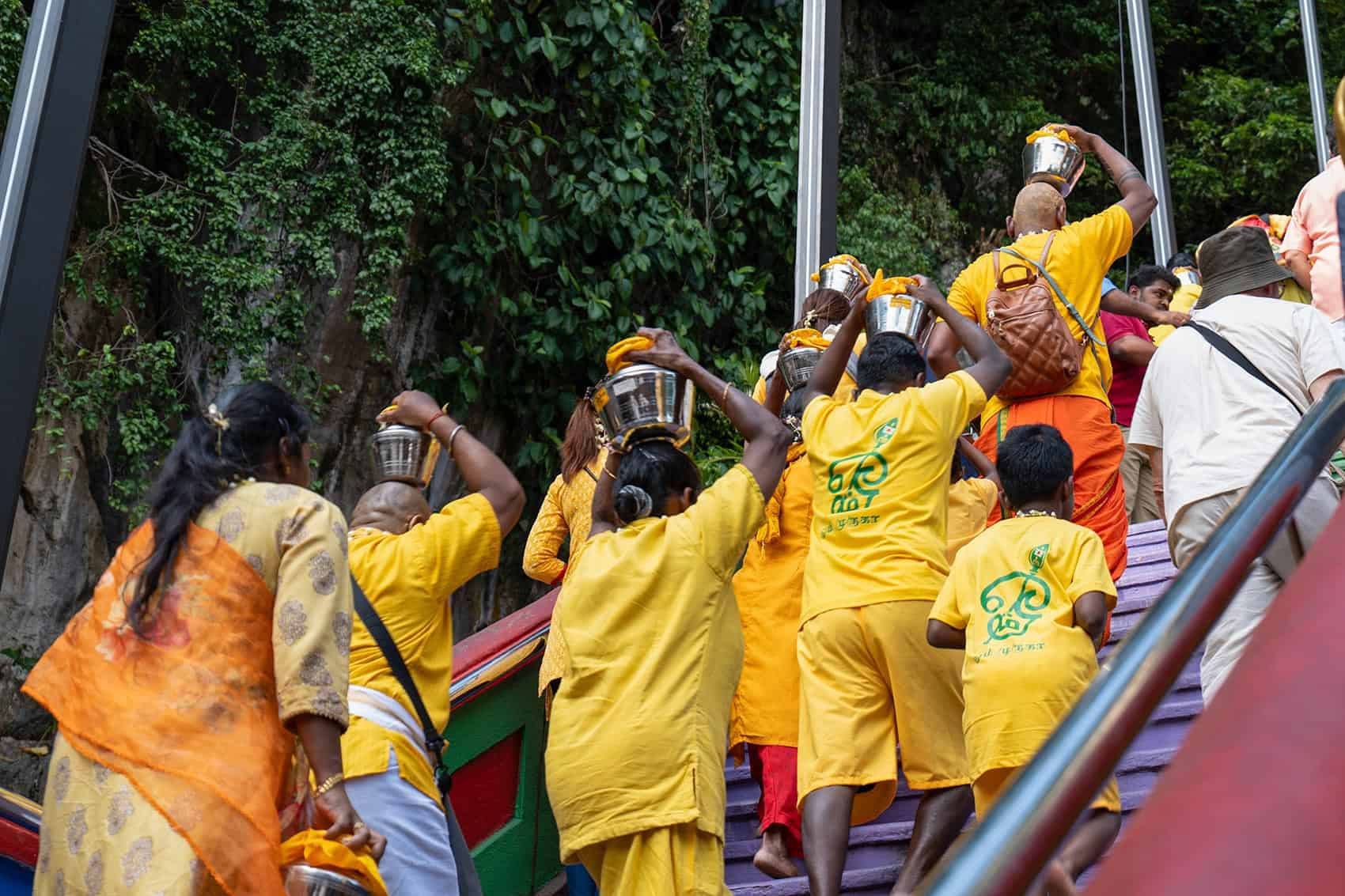
Thaipusam at Batu Caves is Malaysia’s largest religious gathering, held once a year to honour Lord Murugan. The date shifts annually because it follows the Tamil lunar calendar rather than the Gregorian one — the next occurrence falls on Friday, 22 January 2027. Well over a million pilgrims and visitors attend across the festival period.
On the day of Thaipusam itself, the KTM Komuter train is the only way in — no private tours, e-hailing, or taxis can reach Batu Caves. Road closures along the procession route between Chinatown and Batu Caves cause total gridlock from the night before through the following day.
If you want to see the festival atmosphere without the extreme crowds, visit two days before the main date instead. Kavadi preparations and decorations are already visible, roads are still open, and a private tour or transfer to Batu Caves is still possible.
We don’t run tours to Batu Caves on the day of Thaipusam itself — the road closures make it impossible. We recommend booking a standard Batu Caves tour two days earlier instead, when the atmosphere is building and transport is still straightforward.
| THAIPUSAM AT BATU CAVES — QUICK FACTS | |
|---|---|
| Falls on | Full moon of the Tamil month of Thai — different date each year |
| Next occurrence | Friday, 22 January 2027 |
| Chariot departs from | Sri Maha Mariamman Temple, Jalan Tun H.S. Lee, Chinatown KL |
| Transport on the day | KTM Komuter train only — no tours, Grab, or taxis |
| Best day for tourists | 2 days before the main date — roads still open |
| Steps to Temple Cave | 272 |
| Cost to attend | Free |
Thaipusam at Batu Caves is the largest religious gathering in Malaysia — and one you can absolutely attend as a tourist, provided you understand how the day actually works. Well over a million people converge on the Batu Caves temple complex each year, and getting there, moving around, and timing your visit all work differently than on a normal day.
Here’s what happens during the festival, when it falls next, how to get there (and how you can’t), and why we recommend visiting two days early instead of on the day itself.
What Is Thaipusam?
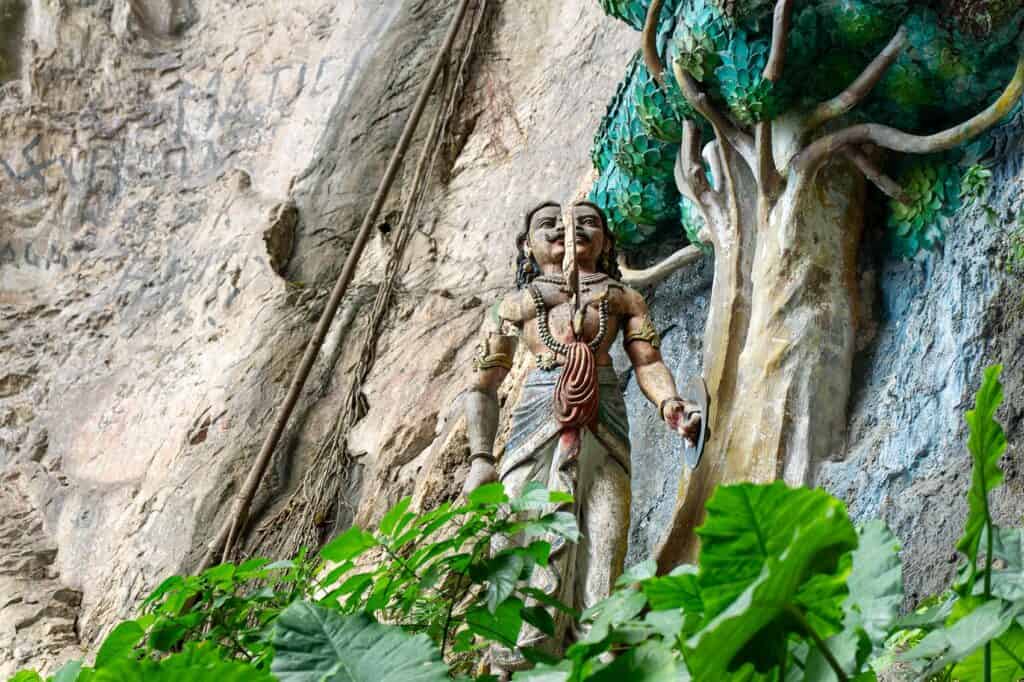
Thaipusam is a Hindu festival celebrated by Tamil communities to honour Lord Murugan’s victory over the demon Surapadman, marked by his receiving the Vel — a divine spear — from his mother, Goddess Parvati, to defeat evil. It falls on the full moon of the Tamil month of Thai, usually in January or February.
The name combines Thai (the Tamil month) and Pusam (the star at its highest point during the festival). For devotees, it’s a day of fulfilling vows — thanking Murugan for an answered prayer, or seeking his blessing through an act of physical devotion.
Batu Caves hosts the largest Thaipusam celebration outside India, drawing devotees from across Malaysia, Singapore, and further afield. That scale is what separates it from Thaipusam observances at smaller temples elsewhere in the country.
The central ritual is the kavadi — a physical burden carried as an offering, ranging from a simple pot of milk balanced on the shoulder to elaborate structures pierced into the skin with hooks and skewers. We cover exactly what this looks like later in this guide.
When Is Thaipusam at Batu Caves?
Thaipusam falls on the full moon of the Tamil month of Thai, so the date shifts every year against the Gregorian calendar — usually landing in late January or early February. The next occurrence at Batu Caves is Friday, 22 January 2027.
Thaipusam is set by the Tamil lunar calendar, not the fixed Gregorian calendar most international visitors are used to. That’s why the date moves by 10 to 12 days each year rather than falling on the same date the way Christmas or New Year does.
The festival itself spans two connected days: chariot night, when the silver chariot departs Kuala Lumpur for its overnight journey to Batu Caves, and the main Thaipusam day, when the kavadi processions and rituals at Batu Caves reach their peak. Most tourist planning should centre on the main day — Friday, 22 January 2027 for the next occurrence.
Because the date is lunar, we update this page every year rather than leave you working off a stale calendar date. If you’re reading this more than a year out from that date, treat it as provisional and check back closer to your travel dates.
What Happens During Thaipusam — the Silver Chariot and the Walk to Batu Caves
The main event starts the night before Thaipusam, when a silver chariot carrying Lord Murugan’s statue leaves Sri Maha Mariamman Temple in Chinatown, Kuala Lumpur, and makes its way roughly 15 kilometres to Batu Caves — a journey that takes most of the night, with tens of thousands of devotees walking alongside or ahead of it.
Sri Maha Mariamman Temple, on Jalan Tun H.S. Lee, is Kuala Lumpur’s oldest and most important Hindu temple, and it’s the official starting point — not the shrine inside Batu Caves itself. Worth knowing if you’re trying to find the procession: search for Sri Maha Mariamman Temple, not “Subramaniam Temple,” which is a different building entirely.
Because the chariot moves at walking pace, the whole route through central KL takes most of the night to cover. Devotees sing, drum, and carry offerings as they go, and the crowds build along the entire path, not just at the start and finish. Batu Caves itself stays open right through the night to receive it — well outside its usual daily opening hours, which don’t apply during the festival period.
By the time the chariot arrives, the real physical act of devotion begins: climbing the 272-step staircase to the Temple Cave, many while carrying a kavadi. That climb, straightforward on a normal day, turns into an hours-long push once the crowd density sets in.
Can Tourists Attend Thaipusam at Batu Caves?
Yes. Thaipusam at Batu Caves is free and open to everyone, regardless of religion or nationality. You don’t need to take part in any ritual — most tourists simply observe from the base of the hill or along the procession route, and that’s completely acceptable.
Nobody will ask you to participate, and nobody expects you to. Hindu festivals in Malaysia are genuinely open events — locals are used to tourists watching respectfully from the sidelines, camera in hand.
Here’s the honest part: attending on the main day itself is a completely different experience from a normal Batu Caves visit. You’re one of well over a million people at the site, the heat and noise are constant, and simply moving through the crowd takes real effort. It’s an incredible thing to witness once — it’s just not necessarily what most first-time visitors to Malaysia picture when they imagine “visiting Batu Caves.”
That’s why most local guides, ourselves included, actually recommend visiting two days before the main date instead of on it. You still see kavadi preparations, decorations, and the festival energy building — without the gridlock and crowd density of the day itself. We explain exactly why further down.
How to Get to Batu Caves During Thaipusam
On Thaipusam day itself, the KTM Komuter train is the only reliable way to reach Batu Caves. No private tours, Grab, or taxis can get through — road closures along the chariot’s procession route combine with festival crowds to bring traffic around Batu Caves to a complete stop.
The road closures start the night before, as the chariot route through central KL and out toward Batu Caves is shut to traffic to let the procession pass. By the time the main day arrives, the roads immediately around Batu Caves are gridlocked with both the festival crowd and every vehicle that tried to get close anyway.
Even if a driver knows the back roads, there’s nowhere to actually drop you off — the entrance area is packed with people, not parked cars. Drivers who don’t know this often try anyway, then sit in traffic for hours going nowhere.
The KTM Komuter line runs a free shuttle service during the festival period specifically to handle the extra volume, with trains running more frequently than on a normal day. It’s slow-moving once you’re inside the station area, but it’s the only transport option that actually works.
For a normal day — any day other than Thaipusam itself — see the full guide to getting to Batu Caves, which covers train, Grab, driving, and tour pickup options.
What to Expect: Kavadi, Piercings, and the Crowd
Thaipusam at Batu Caves involves kavadi bearers carrying decorated frameworks — some pierced into the skin with hooks and skewers — paal kudam devotees carrying pots of milk on their heads, and crowds that build into the millions across the festival period. It’s intense, loud, and physically overwhelming in a way few other events in Malaysia are.
The kavadi is the most visually striking element. Devotees carry elaborate structures, sometimes several metres tall, decorated with peacock feathers and flowers, attached to their bodies with hooks piercing the skin of the chest, back, and cheeks. Some also pierce their tongue or cheeks with a small vel skewer. It looks more painful than participants describe it — many enter a trance-like state through days of fasting and prayer beforehand and report feeling little to no pain during the ritual itself.
Paal kudam is a gentler but equally common form of devotion — mostly women and children carrying small pots of milk on their heads, poured over the deity as an offering once they reach the shrine.
The crowd itself is part of the experience. Well over a million people move through Batu Caves across the full festival period, and on the main day, the base of the hill and the staircase are shoulder-to-shoulder for hours at a time. If you’re sensitive to crowds, heat, or continuous loud drumming, that’s worth knowing before you go — this isn’t a quiet cultural stop.
What to Wear and How to Behave Respectfully at Thaipusam
Dress modestly at Thaipusam — shoulders and knees covered, the same baseline dress code that applies at Batu Caves on any day. Yellow or orange clothing is traditionally worn by devotees and is welcomed if you’d like to wear it, but it isn’t required or expected of tourists.
The standard Batu Caves dress code still applies during Thaipusam: no sleeveless tops, no shorts or short skirts, no exposed shoulders. With crowds this size, sarong hire at the entrance may be slower or harder to access than usual — it’s worth dressing appropriately before you arrive rather than counting on it.
A few behaviour notes matter more during Thaipusam than on a normal visit. Don’t block the path of a kavadi bearer or step in front of a procession mid-climb. Photograph respectfully — a devotee in a trance state carrying a pierced kavadi isn’t a photo opportunity to get close and personal with; a respectful distance and a longer lens serves you better anyway. Avoid flash photography around shrines and pierced devotees.
For the full breakdown of what’s allowed, what to avoid, and how sarong hire works on a normal day, see the Batu Caves dress code guide.
When to Visit Batu Caves Around Thaipusam
The best time to visit Batu Caves around Thaipusam is two days before the main date. Kavadi preparations, decorations, and the build-up in atmosphere are already visible, roads are still open, and a private tour or transfer to Batu Caves is still fully possible — unlike on the day itself.
By two days out, the site is already transforming: temporary stalls go up, devotees begin arriving to prepare their kavadi, and the entrance area takes on a festival energy that a normal day simply doesn’t have. You get a genuine sense of what’s coming, without needing to navigate the crowd and gridlock of the main event.
Roads are still open at this point, which is the practical difference that matters most. A private car or tour can still reach the site directly, park reasonably close, and get you back out again — without the hours-long delays that start once the procession routes close.
One day before is a middle ground — busier, with some road disruption starting as devotees begin the walk from Kuala Lumpur, but still more manageable than the day itself. If you want zero disruption at all, stick to two days before or earlier.
The day itself is different because road closures stack on top of the crowd, not just the crowd itself — as covered above, the KTM Komuter is the only way in once that happens.
Why We Don’t Run Tours to Batu Caves on Thaipusam — and What to Do Instead
We don’t run private tours to Batu Caves on Thaipusam day itself — as covered above, road closures make it impossible to guarantee a reliable pickup, drop-off, or return journey. Instead, we recommend booking a standard Batu Caves tour two days before the festival, when the atmosphere is building and the roads are still open.
It would be easy to offer a workaround — a modified route, a longer pickup window, a promise to “try our best.” We won’t do that. On the day itself, there is no version of a private tour that reliably gets you to Batu Caves and back on schedule. Promising otherwise would be selling you something we can’t deliver.
What we do instead is straightforward: our standard Batu Caves and KL city tour runs normally two days before Thaipusam, when you get genuine festival atmosphere — kavadi preparation, decorations, a visibly different energy at the site — without any of the access problems of the main day. Most visitors who want a taste of Thaipusam without the extreme crowds find this the better trade-off anyway.
If your travel dates only allow the main day itself, the honest advice is to take the KTM Komuter train and go independently — no tour, ours or anyone else’s, can safely do it for you that day.
If you’re deciding between a private, shared, or combo tour for your visit, our Batu Caves tour guide breaks down the differences and helps you pick the right format.
Private Tour — Runs Daily From Kuala Lumpur
Batu Caves and Kuala Lumpur City Tour
See Batu Caves, Merdeka Square, Chinatown, and KLCC Park in one private day out from Kuala Lumpur — with a driver who knows the city and door-to-door pickup that keeps the whole day simple.
Is Thaipusam Suitable for First-Time Visitors or Families?
Thaipusam works best for travellers who are genuinely comfortable in large, crowded spaces — it’s not the easiest way to meet Malaysia for the first time, and it’s not a good fit for families with young children. Between the heat, the crowd density, and rituals that are visually graphic, it’s a demanding day even for confident travellers.
If this is your first trip to the country, it’s worth asking whether Thaipusam is really the introduction you want. Watching it is a genuinely powerful thing to witness, but it drops you straight into Batu Caves at its most overwhelming, with nothing to ease you in first. Plenty of travellers get more out of visiting on an ordinary day, then coming back on a future trip specifically for the festival once they already know the site.
Families should think this through carefully. The piercing rituals can be distressing for children who aren’t prepared for what they’re about to see, and on the main day the crowd is dense enough that keeping track of a small child becomes genuinely difficult. If you do want to bring the family, visiting two days before — the window we recommend throughout this guide — is a far easier version of the experience than the day itself.
Older children and teenagers tend to manage it better, especially if you talk them through what a kavadi and the piercing rituals actually involve before you arrive.
Frequently Asked Questions About Thaipusam at Batu Caves
Information verified: July 2026. Thaipusam falls on Friday, 22 January 2027 based on the Tamil lunar calendar as calculated at time of writing — this page is reviewed annually and the date confirmed closer to each festival. Transport, road closure, and tour availability details are subject to change; confirm with official sources or with us directly close to your travel dates.